Found this on another forum. Mindboggling bit of engineering when you come to think of it!
The world's biggest engine is the Wartsila-Sulzer RTA96-C. It is a turbocharged two stroke diesel engine and it is the most powerful and efficient low revolution engine in the world today. The Wartsila-Sulser is manufactured by the Aioi Works in Japan and is part of Japans Diesel United Ltd engine manufacturers. Below is an 89 foot long 44 foot wide 12-cylinder engine, literally as big as a house!

These large engines are designed to power the world's super oil tankers and large container ships. They are built to the ship owners' preferences. They usually request an engine construction of a single unit and single propeller design for ease of maintenance, and not surprisingly any later troubleshooting. A single unit and single screw design has also proved over time to have a longer life span than double or even quad screws.
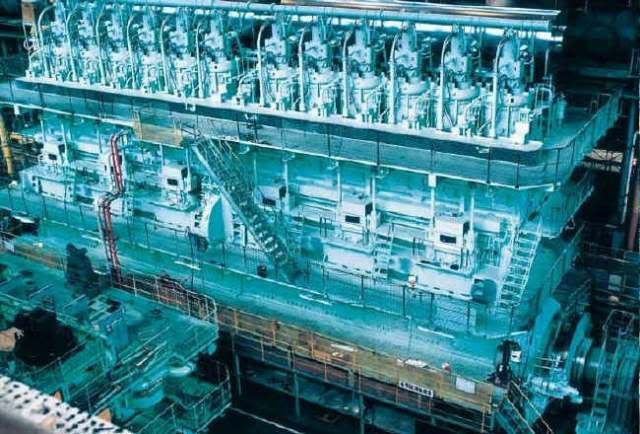
These engines are built in 6, 8, 10, 12 and 14 cylinder configurations. All the engines are straight or 'inline'. The diameter of each cylinder is 3 foot 2 inches with a stroke of 8 foot 2 inches. The 12 cylinder version weighs in at 2000 metric tons and delivers 90,000 Horsepower at 100 Revs per minute, with best fuel economy at 53,244 HP at 90 Rpm. When I mention economy, the 14 cylinder engine for example with a displacement of 25,480 Liters ( 1.56 million cubic inches ) burns up 1,660 gallons of crude ("bunker") oil every hour.
-------------------------
The Mathematical calculation: 1,660 gallons/per hour = 39.5 barrels of crude oil/used per hour = $2,844. These figures are worked out from the basis of crude oil @ $72 a barrel*. $2,844 every hour the engine runs or 27.6 gallons, which is $46.00 every minute or 76 cents a second! That is, of course, if the ships buy oil at trade price...if not, then these figures are the absolute minimum. ( * at time of publishing )
-------------------------
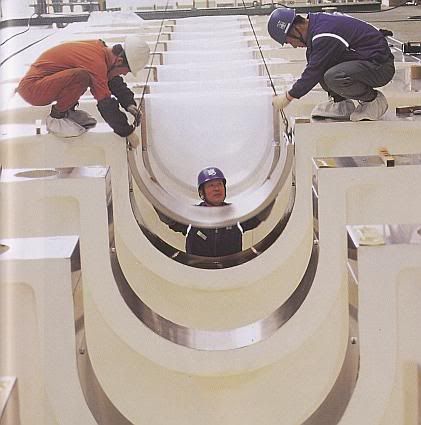
In the image below a worker at the plant is finalizing work on the cylinder block. This image shows the piston sleeves. The worker could quite easily have a nap inside one of the bores and no one would notice!

Below are the pistons that will soon be fitted into the engine. Unlike normal car-sized pistons these 3 foot diameter pistons incorporate lots of holes and it is through these holes that oil is injected through valves to keep all the working parts at a maximum low wear tolerance. Despite the colossal amounts of power output produced by these engines, surprisingly low wear rates have actually been recorded. Cylinder liner wear, for example, is only about 0.03 mm down for every 1000 hours of engine use. It must be remembered here that these engines work at about 20 times slower than a normal 2.0 Liter car engine and this is a major contributor to the life of the engine.

The image below depicts the 300 ton crankshaft of the 10 cylinder engine. You may notice here that there are steps on the wall of the casing to climb down into the engine's sump!

In the image below the pistons shell bearings are being fitted into the engine block. They are lowered into place by a crane and guided in by two workers and a supervisor. They keep all surfaces of the engine clean at this stage, as any grit or dirt could later add wear to the engine, or worse destroy it, so the workers are wearing special cloth overshoes so as not to leave any abrasions on the fine working surfaces. Also you may notice that sheeting is covering the rest of the engine's crankcase bearing housing to keep the dust off. These engines cost many millions upon millions of dollars; in fact, more than the ship itself that they are installed into.
100,000 HP was actually achieved on a test bed in the workshop with the 14 cylinder model, running the engine flat out at just under 102 RPM.






 ..and the Inline 14cyl makes 100,000 bhp!






 Linear Mode


